

Articles · Articles · 15 min
Compliance and Ethics in AI-Powered Hiring Systems
AI hiring tools now face five different compliance regimes and a live lawsuit testing vendor liability. A jurisdiction-by-jurisdiction breakdown
Nov 14, 2026
A candidate applies for a job at 11:47 PM. At 11:49 PM, he gets a rejection. Nobody read his resume in those two minutes. Nobody could have. A model did, and it said no.
That's not a hypothetical. That's the fact pattern behind one of the most closely watched lawsuits in American employment law right now, and it's the reason "the algorithm decided" stopped being a safe sentence to say out loud in an HR meeting sometime around 2024.
I don't build hiring tools. I build agents that do defined jobs and stop when the job is done. But compliance in this space isn't a legal-team problem you can hand off and forget. It's an architecture problem. If your system makes a consequential decision about a real person, the design of that system is now, across a growing stack of state, federal, and EU rules, a matter of public record. Let's go through what's actually true right now, not what a vendor's marketing page says is true, and not what an older article that hasn't caught up yet says is true either.
Accountability for AI Hiring Decisions
Derek Mobley applied to more than 100 jobs through companies using Workday's screening tools. He's Black, over 40, and has a disability. He says he was rejected every time, often within an hour of applying, sometimes fast enough that no human review was plausible.
His case, Mobley v. Workday, Inc., filed in the Northern District of California, has done something no prior AI hiring case had done: it got a federal court to treat the software vendor itself as potentially liable, not just the employer using it.
The court accepted the theory that Workday could be acting as an "agent" of its customers because it was plausibly making the actual accept/reject decisions.
According to the Akin Gump AI Law & Regulation Tracker, on April 29, 2026, the court allowed Mobley's disparate-impact claims to proceed past the motion-to-dismiss stage, based on the degree of automation and decision-making authority in Workday's tool.
By June 22, 2026, a federal judge ruled that Workday must continue facing these claims, and the case is now in discovery with a nationwide collective on the age discrimination count.
That's not a hypothetical risk anymore. It's an active precedent that vendor liability in AI hiring is a live legal theory, not a talking point.
I do not read this ruling as "AI hiring is illegal." I read it as: the party that built the automation can now be sued alongside the party that used it. If you're a vendor, that changes your contracts. If you're an employer, that doesn't get you off the hook. It just means there might be two defendants instead of one.
AI Role in the Hiring Process
Before you match your stack to a law, get one thing straight: "AI hiring system" doesn't mean one tool. I've had people ask me if their video-interview vendor "counts" while assuming their resume screener obviously doesn't, or the other way around. Wrong question. Here's where AI actually shows up in a hiring funnel, in order:
Candidate sourcing and job advertising: algorithms determine which platforms, audiences, or job boards see your listing. A biased sourcing model never shows up in a bias audit, because nobody thinks to look upstream of the applicant pool.
Resume screening and application filtering: the one everyone pictures. Keyword matching, ATS scoring, and pass/fail filters before a human opens a single file.
Candidate scoring and ranking: different from filtering. This process puts a number on a person and hands the recruiter a sorted list, which shapes who gets looked at first even when nobody's technically been rejected.
AI-assisted assessments: skills tests, personality inventories, and cognitive assessments scored or interpreted by a model instead of a person.
Video and voice interview analysis: tools scoring tone, word choice, facial expression, or speech patterns from a recorded interview. This category has drawn the most direct regulatory attention on its own; Illinois passed its AI Video Interview Act specifically because of it.
Interview transcription and summarization: lower stakes on paper, but a summarizer that drops or distorts what a candidate actually said can quietly shape a decision nobody ever audits, because "it's just notes."
Generative AI used by recruiters: a recruiter using a chatbot to draft rejection emails, pre-qualify candidates, or screen written answers. This one gets missed constantly, because nobody thinks of a Slack-side chat tab as "the hiring system."
Every law and case I've covered here defines its scope wide enough to catch several of these at once, on purpose. NYC's Automated Employment Decision Tool definition and the EU's Annex III employment category aren't narrow by accident. If you audit the resume screener because that's the one everyone pictures when they hear "AI hiring" and skip the other six, you haven't done a compliance review. You've done a compliance review of one-seventh of your exposure.
Understanding Legal Requirements for Your Hiring Stack
There isn't one AI hiring law. There are at least five moving at different speeds, plus a federal floor underneath all of them that I'll get to later, and most compliance advice online blurs them together. Here's where each one actually stands today, not when it was first announced, and we will walk through one jurisdiction at a time.
NYC Local Law 144 Compliance
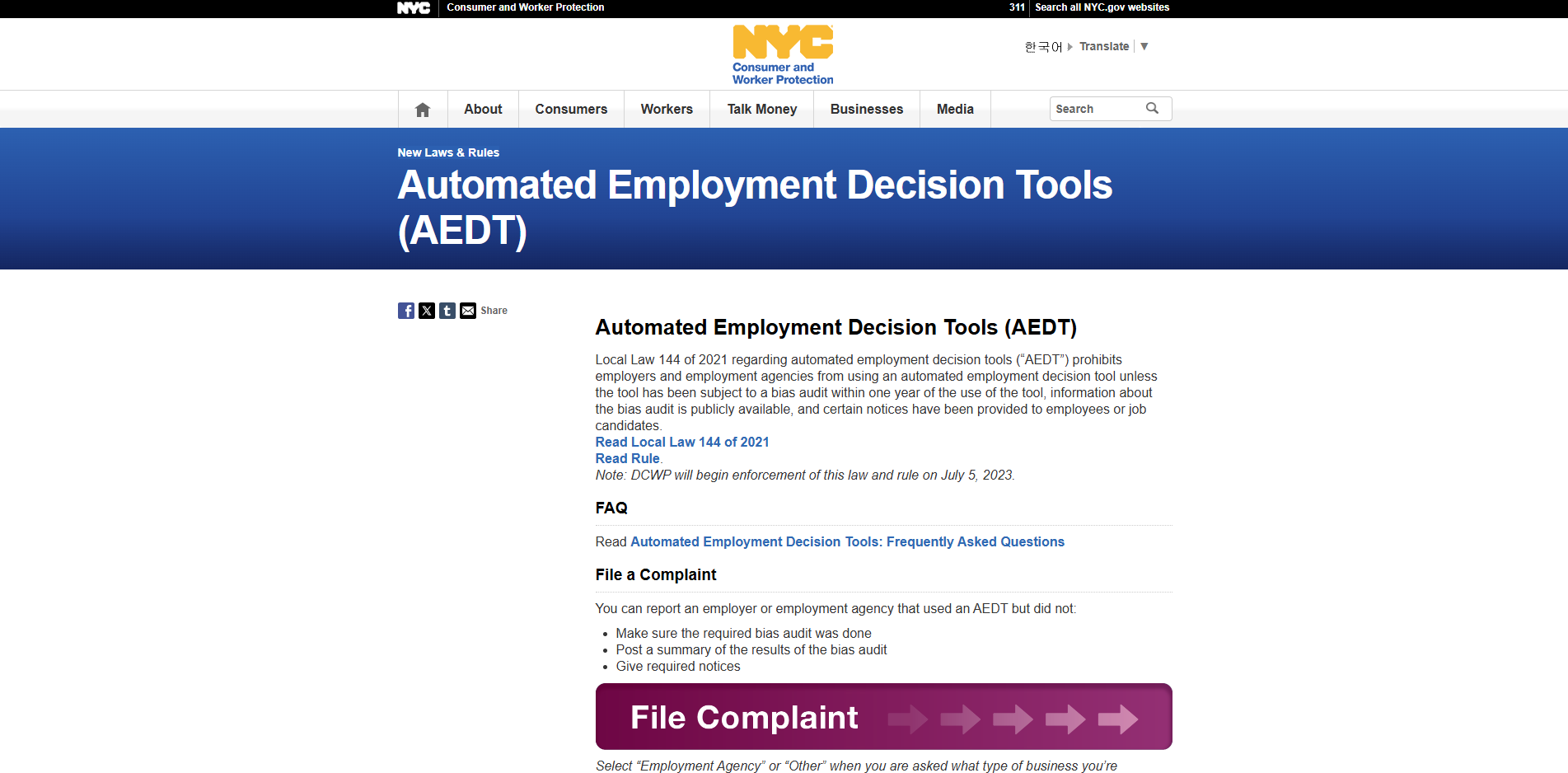
Local Law 144 has been treated as toothless for most of its life. That's changing fast.
According to a DLA Piper client alert from January 30, 2026, a New York State Comptroller audit released in December 2025 concluded DCWP's enforcement of Local Law 144 was "ineffective," citing weak complaint-handling and inaccurate compliance reviews.
Across a sample of 32 companies, auditors flagged at least 17 potential violations where the city's own enforcement agency had found only one.
That mismatch is exactly the kind of finding that causes an agency to overcorrect.
If you're using any resume screener, video-interview scoring tool, or skills assessment for a role tied to New York City (including a remote role a NYC resident could fill) and you don't have a bias audit, a public summary, and a candidate notice in place, you are not "probably fine because nobody's checking."
Somebody is checking now, and they were just told publicly they weren't checking hard enough.
California AI Hiring Compliance
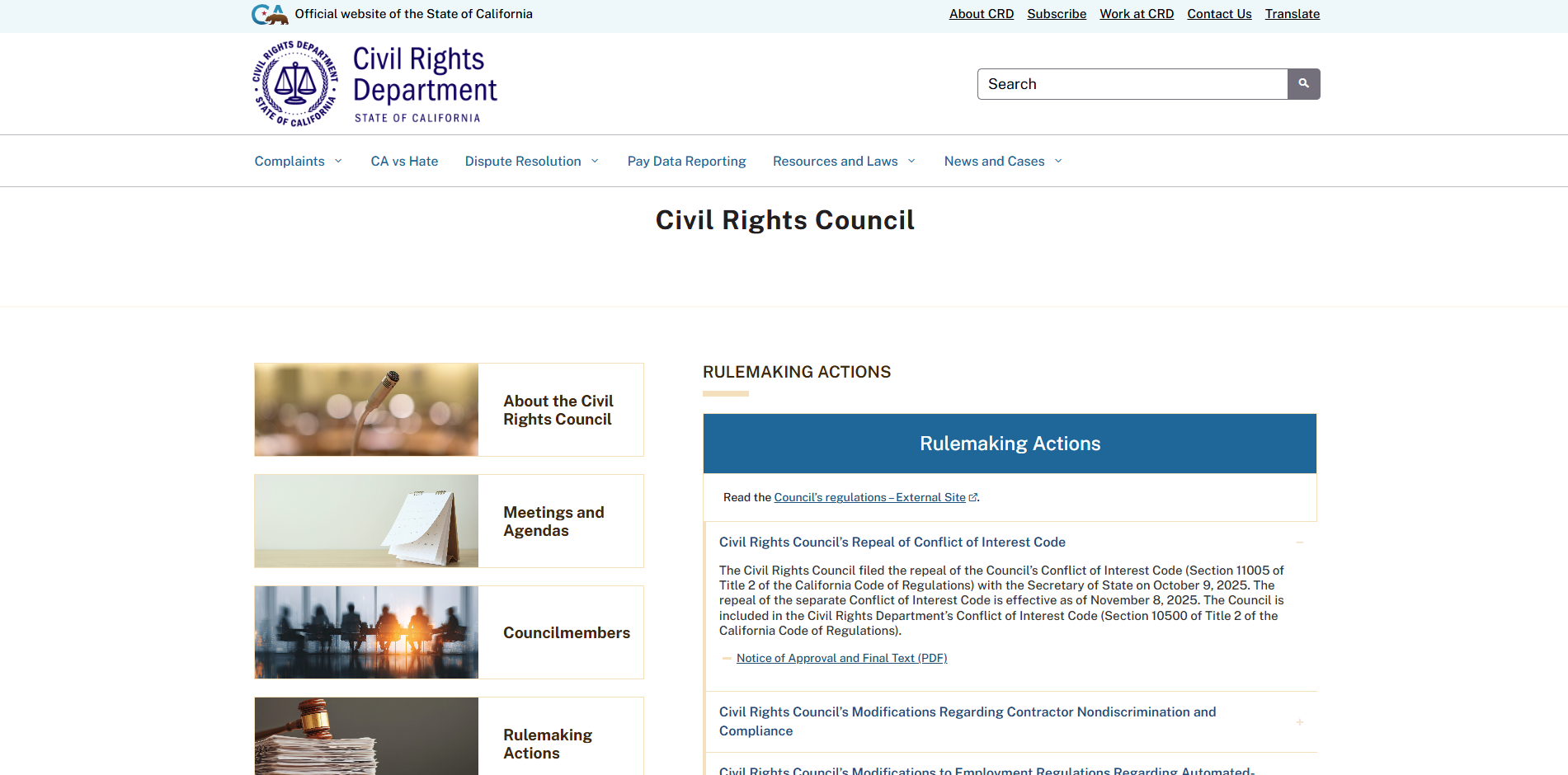
California didn't wait around for a dedicated AI statute. It amended the rules under the law it already had.
The Civil Rights Council's regulations addressing automated decision systems under the Fair Employment and Housing Act (FEHA) became effective October 1, 2025.
They clarify that an automated system producing a discriminatory outcome is an FEHA violation, full stop.
They extend the state's employment recordkeeping requirements to cover automated-decision data specifically: your resume screener's scoring logs are now employment records you're required to keep, the same as an interview scorecard would be.
There's no separate "is the algorithm compliant" question in California. There's one question: did the automated system produce a discriminatory outcome, and can you produce the records to show it didn't?
A vendor's compliance claims don't change who has to answer that.
Illinois AI Hiring Requirements
Illinois runs two separate rules that both catch AI in hiring, and most compliance guides only mention one of them.
AI Video Interview Act (older, on the books for years): notify candidates before AI analyses a recorded interview, get consent, limit who can access the recording, and destroy it within 30 days of a request.
HB 3773 (in force since January 1, 2026): amends the Illinois Human Rights Act directly to prohibit employers from using AI (including generative AI) in recruitment, hiring, promotion, discipline, or discharge if the result is discrimination against a protected class, plus a notice requirement when AI is used for a covered employment purpose.
The word to notice is "result," not intent. Illinois isn't asking whether you meant for the tool to discriminate. It's asking whether it did so.
That's the same disparate-impact logic federal law has used for decades, just written directly into a state statute for AI specifically.
Colorado AI Hiring Regulations
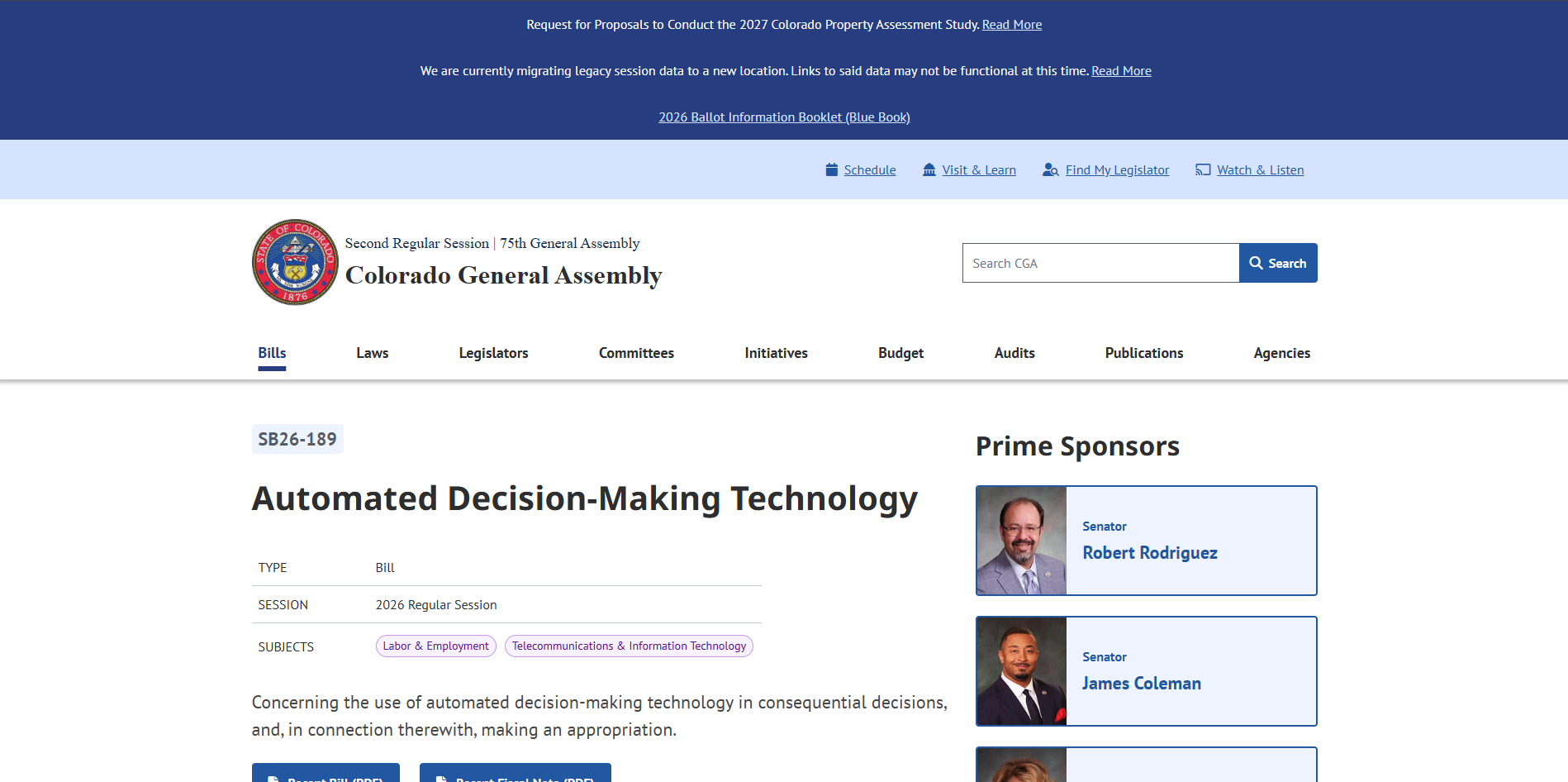
Colorado's original AI Act got a lot of press in 2024. It's already gone, replaced by a new law most articles haven't caught up to yet.
Colorado's original AI Act (SB 24-205) was signed in 2024, then spent 2025 and early 2026 getting delayed, stayed, and was rewritten before it ever took effect.
In May 2026, Colorado completed the process: SB 26-189 was enacted, fully repealing the original framework and replacing it with a narrower "automated decision-making technology" regime. It takes effect January 1, 2027.
Employment is named explicitly as one of the law's covered "consequential decision" areas.
Employers using automated decision-making technology for hiring, promotion, or similar decisions owe candidates pre-use notice, a 30-day adverse-action notice when someone is turned down, the ability to correct data used against them, multi-year recordkeeping, and meaningful human review following certain adverse outcomes, not just a human technically sitting somewhere in the loop.
If you've read a guide that talks about "SB 24-205" or describes Colorado's law as "delayed" or "stayed," it's describing a law that no longer exists. The current law is SB 26-189, and the clock starts January 1, 2027.
EU AI Act Employment Rules
This deadline is the one most US-based teams get wrong, because the headline "August 2026 EU AI Act deadline" stopped being accurate on June 29, 2026.
According to Forkast News, on August 10, 2026, the Digital Omnibus, approved by the European Council on June 29, 2026, defers high-risk employment AI obligations by 16 months.
High-risk employment obligations (CV sorting, candidate screening, performance monitoring) moved from Aug 2, 2026, to Dec 2, 2027.
Transparency obligations for AI systems that interact with people, such as telling a candidate "an AI system is being used to review your application," remain on the original August 2, 2026 date.
Two different clocks, two different obligations. Conflating them either makes you scramble for a deadline that isn't real yet or miss one that is.
The Act's prohibited-practices tier has already banned the use of AI to infer someone's emotions in workplace or recruitment settings since February 2, 2025, with only narrow medical or safety exceptions, and this ban is fully enforceable regardless of either date.
Running an emotion-detection layer over a video interview isn't a future problem you can plan around. It's already against the rules.
Five laws, side by side
Here's the same ground in one table, now that you've seen the reasoning behind each row:
Jurisdiction | Status right now (Sept 2026) | What it actually requires | What happens if you ignore it |
|---|---|---|---|
NYC Local Law 144 | In force since July 2023. Enforcement found "ineffective" by a Dec 2025 state audit, now ramping up. | Independent annual bias audit of any Automated Employment Decision Tool, public posting of results, 10-business-day candidate notice, opt-out option. | $500–$1,500 per violation, per tool, escalating for repeated non-compliance. |
California (Civil Rights Council / FEHA) | In force since Oct 1, 2025. | Clarifies that an automated decision system producing a discriminatory outcome is an FEHA violation; extends the state's employment recordkeeping requirements to automated-decision data specifically. | Standard FEHA liability: the tool is not treated as a separate legal actor from the employer. |
Illinois (HB 3773 + AI Video Interview Act) | HB 3773 in force since Jan 1, 2026. The Video Interview Act has been live for years. | HB 3773: prohibits AI in hiring, promotion, discipline, or discharge that results in discrimination against a protected class (regardless of intent), plus a notice requirement. Video Interview Act: candidate notice and consent, restricted recording access, destruction within 30 days of a request. | Illinois Human Rights Act violation. Outcome-based, not intent-based. |
Colorado (SB 26-189) | Enacted May 2026, fully replacing the earlier SB 24-205 framework. Takes effect Jan 1, 2027. | Names employment as a covered "consequential decision" area: pre-use notice, 30-day adverse-action notice, a right to correct data used against you, multi-year recordkeeping, meaningful human review after certain adverse outcomes. | Not yet enforceable, but the clock starts Jan 1, 2027, not "eventually." |
EU AI Act | Split in two on June 29, 2026 via the Digital Omnibus. | Transparency obligations (disclosure that AI is used) already live since Aug 2, 2026. The heavier high-risk obligations (risk assessments, human oversight, conformity checks) were pushed to Dec 2, 2027. Separately, using AI to infer emotions in a workplace or recruitment setting has been banned outright since Feb 2, 2025. | Up to €15 million or 3% of global turnover once the high-risk tier lands. The emotion-inference ban is enforceable right now. |
The test is not simply whether there is a law. The test is which specific obligation, in which specific place, applies to the specific tool I am running today. Those are five different answers, plus a sixth that never changes regardless of where you operate: federal discrimination law. I've watched teams build one compliance checklist and assume it covers everything. It never does.
Federal Discrimination Rules in AI-Assisted Hiring
Everything above is a law that exists specifically because of AI. None of it is the floor. The floor is ordinary federal discrimination law, and it applies whether or not your state, or the EU, has passed a single word about artificial intelligence.
Title VII, the ADA, and the ADEA don't ask what tool made a hiring decision.
The EEOC's existing framework prohibits discrimination in hiring based on protected characteristics.
A facially neutral practice can still be unlawful if it disproportionately harms a protected group and the employer can't show it's job-related and consistent with business necessity. That's disparate impact doctrine, and it predates every law in the table above by decades.
Mobley v. Workday isn't built on any state's AI statute. It's built on the ADEA and Title VII.
A company hiring only in states with zero AI-specific law on the books is still fully exposed if its screening tool produces a skewed outcome.
The four-fifths rule mentioned earlier isn't a Colorado invention or an EU invention. It's a decades-old federal enforcement standard that state AI laws are now just formalizing with audit requirements bolted on top.
The test to actually apply: if every AI-specific law on that table vanished tomorrow, would your hiring tool still be defensible under Title VII? If the honest answer is "I don't know," the state-law compliance checklist was never the real project.
Compliance and Ethical Hiring Are Not the Same
Here's the distinction I actually care about, separate from any of the above: passing a legal audit and making a defensible decision are not the same achievement.
The test is not, "Did we break a law?". The test is: "Can we explain this decision, in plain language, to the person it happened to, and have it hold up?”
A tool can pass a Local Law 144 bias audit and still make decisions nobody can explain to a rejected candidate in a sentence. Disparate impact analysis (the "four-fifths rule": if one group is selected at less than 80% of the rate of the highest-selected group, that's a red flag worth investigating) is a floor, not a target. Real ethical practice in this space means:
A human reviews edge cases and reversals, not just a dashboard of aggregate pass rates.
Candidates can ask, "Why was I rejected?” and get an answer that isn't "the system flagged a mismatch."
The training data and scoring criteria are documented well enough that you could hand them to an outside auditor without redrafting your defense first.
Vendor contracts now explicitly assign liability for automated decisions, given what Mobley v. Workday just established about vendor exposure
I have watched teams treat the legal minimum as the ceiling instead of the floor. That's a mistake that shows up in a lawsuit a year or two later, not in this quarter's compliance report.
Building an AI Hiring Compliance Process
If I were auditing a hiring stack tomorrow, here's the order I'd check things in:
Inventory every tool that touches a hiring decision: resume screeners, video scoring, skills tests, and chat-based pre-screens. If it ranks, scores, or filters candidates, it counts.
Map each tool against every jurisdiction your candidates are actually in: not where your company is headquartered. A remote NYC-based applicant triggers Local Law 144, a California-based one triggers the FEHA automated-decision rules, and an Illinois-based one triggers HB 3773, regardless of where your office sits.
Get the bias audit and documentation in place before enforcement catches up, not after: the NYC pattern shows regulators go from "ineffective" to "aggressive" fast once they're publicly called out.
Rewrite vendor contracts to assign liability explicitly: Mobley v. Workday means that saying "our vendor is compliant" no longer protects you.
Separate your transparency obligations from your high-risk obligations on a calendar, especially for the EU and Colorado, where notice requirements and the heavier obligations now run on different clocks.
Run the federal disparate-impact assessment regardless of which state laws apply: Title VII doesn't care whether your state has passed anything AI-specific yet.
Questions
No. No major jurisdiction bans it outright. What's regulated is how it's audited and disclosed and who's held accountable when it produces a discriminatory outcome.
Increasingly, no. Mobley v. Workday is built on the argument that outsourcing the decision doesn't outsource the liability, and it's currently surviving in federal court.
Possibly some of them apply, and definitely one thing that isn't on that list at all: federal discrimination law. NYC Local Law 144 applies to any role a NYC resident could fill remotely. The EU AI Act requires any company whose systems affect EU residents to comply regardless of where the company is headquartered. Check the candidate's location for state and EU laws, but assume the federal floor applies no matter where you are.
No. Every law covered here adds obligations on top of Title VII, the ADA, and the ADEA. None of them lower or replace the federal bar.
The single most significant compliance mistake right now is treating one jurisdiction's rulebook as if it covers all of them, or treating AI-specific law as the whole picture and forgetting that ordinary federal discrimination law was always required.
Conclusion
New York, California, Illinois, Colorado, and Brussels will each keep rewriting their own versions of this law. Title VII won't move. It was the floor before any of them existed, and it remains the floor no matter which state changes a deadline next.
The actual test is simpler than the table above makes it look; can you say the real reason for a rejection out loud to the candidate it happened to? Mobley v. Workday exists because a company couldn't, and its vendor is now defending that same failure right alongside it. That exposure doesn't stop at the resume screener. It reaches the recruiter who used a chat tab to draft the rejection without ever thinking of it as part of the hiring system.
So skip the audit for whichever law you happen to be under this quarter. Write the sentence you'd have to say to a rejected candidate's face first. If you can't write it today, every audit on that table has failed.
Next