

Articles · Articles · 18 min
AI for ecommerce returns and refunds: platforms tested in 2026
We tested 8 AI platforms for ecommerce returns and refunds in 2026, YourGPT, Loop, Gorgias, Siena, Narvar, ReturnGO, and more, so you know which one actually fits your store.
Nov 10, 2026
A customer clicks "Start a return." What happens in the next ten seconds decides whether your store just lost a sale or handled a normal Tuesday.
Returns aren't a small problem anymore. U.S. shoppers sent back $849.9 billion worth of merchandise in 2025, according to the National Retail Federation. That's 15.8% of everything retailers sold. Online orders come back even more often, almost one in five. And the same report found that 9% of all returns are outright fraud.
Most stores still treat the situation like a support ticket. It isn't. It's money leaking out of your margins in real time.
So I tested eight platforms retailers actually pay for to handle this: five dedicated returns apps and three AI agents that treat returns as one job among several. Here's where each one actually works, and where it just pushes the same paperwork somewhere else.
Testing Every Platform
Every platform got graded against the same fictional merchant: a $2M-a-year apparel brand doing roughly 150 returns a month. That kept pricing and feature gates that move with volume from flattering anyone.
Four scenarios ran against each platform's documented flow: an eligible refund, a size or style exchange, a late return, and a case that should trip fraud detection. Where a self-serve trial exists, I walked the scenario through the actual product. Where it's locked behind a sales call (Narvar, Happy Returns' negotiated tiers, Siena, Loop's Enterprise plan), the assessment rests on vendor documentation and verified merchant reports instead, and I say so per platform.
Finish line for each task: a scenario only counts as finished if the platform completes it end to end (refund issued, exchange processed, or the case correctly escalated to a person) without someone re-keying order data into a second system. A platform that can explain what should happen but fails to make it happen receives no credit for the scenario.
Native versus custom: every platform was checked for what it does the day you sign up against what needs a developer, a paid implementation package, or a separate app to bolt on. That line is called out per platform above, because a vendor's own marketing rarely draws it for you.
What counted as a pass: completing at least three of the four scenarios end to end, or, for platforms with no live sandbox, the vendor's own documentation naming the capability as shipped, not as a roadmap item or a sales-deck promise.
Pricing: checked against each vendor's own pricing or help-center page first. Independent breakdowns only filled in what a vendor won't publish outright, and I re-checked every number against at least two sources, because several of these pricing pages disagree with each other. Where they still didn't agree after that, the post says so instead of picking whichever figure looked cleaner.
Quick glance
YourGPT: No-code AI agent platform that lets you build return logic around your policy, with one agent for support, sales, and returns instead of a separate app.
Gorgias AI Agent: Shopify-native helpdesk AI that reads the order and issues the refund inside the ticket, built for stores already running Gorgias.
Loop Returns: Exchange-first returns platform for Shopify apparel and footwear brands that want refunds converted into revenue, not lost to it.
AfterShip Returns: The cheapest credible entry into AI-assisted returns, bundled with AfterShip's tracking platform on the same customer record.
ReturnGO: Fraud-focused returns platform that flags serial returners and policy abuse before a refund ever goes out.
Siena: AI CX agent for DTC brands that executes refunds and return actions in a consistent, on-brand voice, layered on top of your existing helpdesk.
Narvar: Enterprise post-purchase platform for large, recognizable retailers treating the return as a brand-loyalty moment, not a cost line.
Happy Returns: Physical, box-free return network, now run by UPS, for brands with enough volume to justify 8,000+ drop-off locations.
Best AI platforms for ecommerce returns and refunds
Here's a closer look at each platform: what it does, what it costs, and who it actually fits.
1. YourGPT
YourGPT is a no-code AI agent platform for customer support, sales, and operational automation, not a purpose-built returns app. A team feeds it their actual return and refund policy as context, then wires an agent to check an order against that policy and take whatever action they've connected it to: approve, deny, refund, or hand off to a person. Returns become one workflow among several rather than the whole product. Its AI Helpdesk module is where a returns workflow would actually live.
Features:
No-code AI agent builder trained on your own business data: website, PDFs, CSVs, help-center content
AI Helpdesk module for ticket-style resolution, including refund and return requests
Self-learning from unresolved conversations to close knowledge gaps over time
Built-in escalation to a human agent when a request falls outside configured policy
API and webhook support for connecting the agent to order and payment systems (Professional tier and up)
Advantages:
Not locked to one ecommerce platform or one workflow; the return logic is yours to define
Flat per-workspace pricing with no per-seat or per-resolution fee, unlike Gorgias or Siena's billing model
The same agent extends into sales and general support without buying a second tool
Disadvantages:
No pre-built returns portal, drop-off network, or exchange-conversion flow; that has to be designed and configured
Fewer named ecommerce-specific integrations (Shopify, Loop, Recharge) documented publicly than dedicated returns vendors
Pricing:
Essential: $39/month billed annually: 2 chatbots, 10 million AI credits, 3 team members
Professional: $79/month billed annually: 5 chatbots, 30 million AI credits, AI Helpdesk, self-learning, human escalation
Advanced: $349/month billed annually: 10 chatbots, 100 million AI credits, custom branding, and domain
Enterprise: custom annual contract with dedicated support and SSO
Best for: Teams that want returns handled by the same AI agent that already runs their support and sales, without adopting a separate returns app.
2. Gorgias AI Agent
Gorgias is a Shopify-first helpdesk with an AI Agent layer that resolves tickets using live store data. For a return specifically, it reads the order, checks it against store policy, and can issue a refund, start an exchange, or edit a subscription without a human touching the ticket. It runs across chat, email, and SMS and hands off to a person with full context when it can't finish the job or detects frustration. Because the AI Agent is billed on top of the base helpdesk plan, the real cost only becomes clear once automation volume is factored in.
Features:
AI Agent resolves WISMO, returns, exchanges, cancellations, and subscription edits using live Shopify order data
Native integrations with Shopify, Recharge, and Loop Returns
Runs across email, chat, SMS, and voice
Human handoff with full conversation context on frustration or out-of-scope requests
Shared inbox with rule-based automation (Flows, Quick Responses) alongside the AI layer
Advantages:
Deep, native Shopify order actions: actual refunds and edits, not just answers
Combines pre-purchase shopping assistance and post-purchase support in one agent
Well-established in the Shopify ecosystem, with a wide app-store integration list
Disadvantages:
Double-billed automation: every AI resolution counts as a billable helpdesk ticket plus a separate per-resolution fee
Shopify-only by design; other platforms need custom HTTP actions to get similar functionality
Pricing (billed annually, with the AI Agent added):
Basic: $77/month. 300 tickets and 30 automated interactions
Pro: $471/month. 2,000 tickets and 190 automated interactions
Advanced: $1,227/month. 5,000 tickets and 530 automated interactions
Voice and SMS are separate add-ons, from $25/month and $17/month, respectively, on annual pricing
Best for: Shopify stores that already run support through Gorgias and want refunds resolved inside the same ticket.
3. Loop Returns
Loop is a returns-management platform built specifically for Shopify apparel and footwear brands, and its entire design treats a refund as a failure state to prevent, not a request to process. Instead of just processing a return, it steers the customer toward an exchange, store credit, or an immediate repurchase through its "Shop Now" flow. It's one of the more mature, widely adopted platforms in this category, with its strongest features gated behind an annual contract.
Features:
Branded, self-service return portal enforcing your automated return policy
"Shop Now" and Instant Exchange flows that convert refund requests into new purchases
Bonus credit incentive that pushes customers toward store credit over cash refunds
Fraud prevention tools at the Advanced tier
Carrier rate shopping and unlimited return destinations
Advantages:
Strong, proven exchange-conversion mechanics purpose-built for apparel and footwear
Free Checkout+ tier available for merchants clearing a high annual order volume
Mature product with a long track record in the Shopify apparel space
Disadvantages:
Both paid tiers require an annual contract, with no month-to-month option
The revenue-retaining features (Shop Now, Instant Exchange, fraud prevention) sit behind the pricier Advanced tier, not Essential
Pricing:
Checkout+: free for merchants with roughly 10,000+ annual orders
Essential: $155/month (annual contract)
Advanced: $340/month (annual contract)
Enterprise: custom pricing
Best for: Shopify apparel and footwear brands that want refund requests converted into exchanges instead of lost revenue.
4. AfterShip Returns
AfterShip Returns Center is the returns module of AfterShip's broader post-purchase platform, best known for shipment tracking. It gives customers a self-service portal to request a return, auto-generates the RMA, and, on its higher tiers, layers in AI-powered exchange suggestions and fraud-pattern detection. Its main edge over dedicated returns specialists is unification: tracking, notifications, and returns all live on the same customer record, at entry pricing that undercuts most of the category.
Features:
Self-service return portal with automatic RMA generation
AI-powered exchange suggestions tailored to the shopper, at the Premium tier
Fraud-pattern detection for serial returners and policy abuse
Pre-built integrations with ERPs, WMS, marketing, and support tools (Klaviyo, Gorgias, Zendesk, NetSuite)
Shared customer record across AfterShip's tracking, notifications, and returns products
Advantages:
Cheapest credible entry point into AI-assisted returns on this list
Unifies tracking and returns data if you already run AfterShip for shipment tracking
Broad pre-built integration list reduces custom development work
Disadvantages:
No equivalent of Loop's exchange-first conversion psychology; built for throughput, not revenue retention
AI-powered features are gated to the Premium tier, not included at entry pricing
Pricing:
Essentials: from $16/month (annual), under 100 returns/month, branded portal, refunds and exchanges, automatic labels
Premium: from $99/month (annual), 100–400 returns/month, adds AI-powered exchanges, fraud prevention, and advanced analytics
Enterprise: custom, for 400+ returns/month, adds custom API limits, dedicated onboarding, and SSO
Best for: Teams already using AfterShip for tracking who wants returns on the same platform at a low entry cost.
5. ReturnGO
ReturnGO is a returns-management platform built around one specific problem: return fraud and policy abuse. Rather than leading with exchange conversion or brand experience, it analyzes customer return history and behavioral patterns to flag high-risk requests before a refund goes out. It runs a self-service branded portal like its competitors, but the pattern-matching layer is the differentiator, and it covers more platforms beyond Shopify than most of the others here.
Features:
Self-service return portal with customizable return reasons and policy rules
Behavioral pattern-matching to flag serial returners and wardrobing
Store credit, gift cards, and variant-exchange options as refund alternatives
Automated return label generation
Multi-channel support: Shopify, WooCommerce, Magento, BigCommerce, and more
Advantages:
The clearest fraud and abuse focus of any platform on this list
Wider platform coverage than most Shopify-only competitors
14-day free trial available on subscription plans
Disadvantages:
Third-party pricing listings disagree with each other by a wide margin, so get a direct quote rather than trusting the first number you find
Narrower value if you already run fraud detection elsewhere in your stack
Pricing:
Premium: from $147/month
Pro: from $297/month
Enterprise: custom pricing, contact required
Best for: Brands that are losing real money to return fraud or policy abuse, not just in return volume.
6. Siena
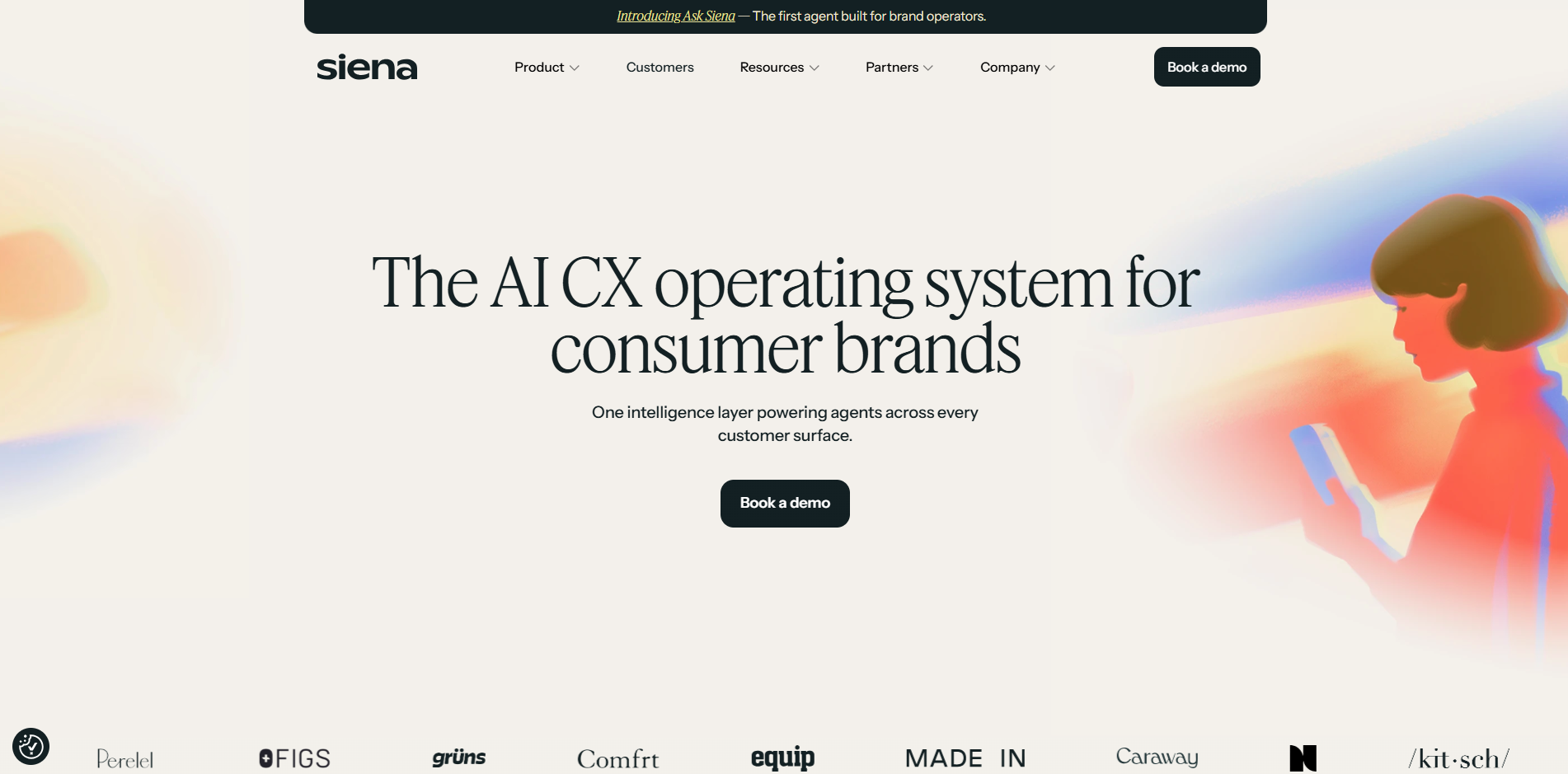
Siena is an AI customer-service agent built specifically for DTC ecommerce brands, positioned as an "AI CX operating system" that layers on top of an existing helpdesk (Gorgias, Zendesk, Kustomer, Gladly, or Dixa) rather than replacing it. Beyond answering questions, it executes actions: issuing refunds, generating return labels through Loop Returns, updating shipping addresses, and pausing or swapping subscriptions, all inside one conversation. Its differentiator is brand voice: a "Personas" feature tunes tone per brand, which several premium DTC customers cite by name.
Features:
Executes refunds, return labels, and address changes directly through Shopify, Loop Returns, and AfterShip
Deep subscription management via Recharge, Skio, Smartrr, and others
Brand-tuned "Personas" for consistent tone across conversations
Sits on top of existing helpdesks rather than replacing them
Additional shopping, reviews, and QA agents beyond core customer service
Advantages:
Strong ecommerce-specific action-taking, not just conversational deflection
Genuine focus on brand voice, which matters for premium DTC positioning
SOC 2 Type II and GDPR compliant
Disadvantages:
No fixed all-in plan price; the $750 platform fee and $0.90 per-ticket rate are public, but the final tailored total still requires submitting team size and ticket volume
Automation-rate claims vary widely by customer, reported anywhere from roughly 36% to 94%, so the commonly cited "80%" figure shouldn't be read as a guarantee
Pricing:
Platform fee: $750/month, covering the core AI engine and unlimited sandbox access
Automation Pack: $0.90 per automated ticket
Support & Implementation priced separately, covering onboarding and dedicated Slack support
A final tailored quote still requires submitting team size and monthly ticket volume through Siena's own pricing form
Best for: DTC subscription brands that want ecommerce-specific actions handled with a consistent, on-brand tone.
7. Narvar
Narvar is an enterprise post-purchase platform used by large, recognizable retailers to manage tracking, notifications, and returns as one branded experience. Its returns module, Narvar Shield, runs on the same proprietary IRIS AI engine that powers its delivery-estimate and fraud-prevention products, and it's explicitly built to convert refund requests into exchanges rather than just process them. Pricing is never published, and the sales process assumes a large-scale retailer from the outset.
Features:
Branded, self-service returns portal via Narvar Shield
IRIS AI engine also powers delivery-date estimates (Narvar Promise) and delivery-fraud detection (Narvar Assist)
Shipping protection product (Narvar Secure) for lost, stolen, or damaged items
Claims up to 60% conversion of refund requests into exchanges
Used by large retail brands including Sephora, Levi's, and Warby Parker
Advantages:
Deep AI investment across the whole post-purchase journey, not just returns
Proven at a genuine retail scale with recognizable brand customers
Bundles delivery estimates, returns, and fraud prevention under one AI engine
Disadvantages:
No published pricing anywhere; third-party estimates range from the tens of thousands to $250,000+ a year once modules are added
Implementation typically takes six to eight weeks
Pricing:
Not publicly disclosed; Narvar runs on a custom, sales-negotiated quote based on order volume, modules activated, and contract length
Best for: Large, recognizable retail brands that treat the post-purchase experience as part of their brand, not just an operational cost.
8. Happy Returns
Happy Returns solves a different part of the problem entirely: it removes the box and label from the return. Customers scan a QR code and drop the item at a staffed return bar (over 8,000 of them across the US, mostly inside UPS Store and partner retail locations) and get an instant refund. One correction worth making up front: it's no longer "PayPal's Happy Returns." PayPal acquired it in 2021 and sold it to UPS in November 2023, so it now runs as part of UPS's logistics network.
Features:
Box-free, label-free returns at 8,000+ physical Return Bar locations
Instant refund issued at the point of drop-off
Item verification and AI-based fraud risk scoring at the counter
Consolidated shipping from Return Bars to reduce reverse-logistics cost
Runs as part of UPS's broader shipping and logistics network
Advantages:
The only platform on this list solving returns through a physical, staffed network rather than a digital portal
Instant refund at drop-off is a meaningfully better customer experience than a mail-in return
Backed by UPS's existing logistics infrastructure
Disadvantages:
Value depends heavily on customer proximity to a return bar, so it's less useful for smaller or geographically scattered customer bases
Pricing is entirely custom and negotiated through UPS, with no public rate card
Pricing:
Not publicly listed; priced through a custom, volume-based UPS enterprise quote
Best for: Retailers with enough return volume and customer density to justify a physical, box-free drop-off network.
Side-by-side comparison
Comparison Basis | YourGPT | Gorgias AI Agent | Loop Returns | AfterShip Returns | ReturnGO | Siena | Narvar | Happy Returns |
|---|---|---|---|---|---|---|---|---|
Return & Refund Automation | Yes, native solution | Yes, native in-ticket | Yes, core product | Yes, core product | Yes, core product | Yes, via helpdesk overlay | Yes, core product | Yes, at drop-off |
Action Depth & Execution | Executes whatever actions are connected | Issues refunds directly | Issues refunds and exchanges | Issues refunds, generates RMA | Issues refunds, exchanges, labels | Issues refunds, labels, address changes | Issues refunds and exchanges | Instant refund at the counter |
Return Policy & Decision Logic | Fully custom; you define the policy | Applies store policy via configured Skills | Automated policy rules | Automated policy rules | Rule-based plus behavioral logic | Enforces defined policies and thresholds | Policy-based via Narvar Shield | Basic eligibility check at drop-off |
Fraud Detection & Prevention | requires custom logic | Not a core focus | Fraud prevention at Advanced tier | Fraud-pattern detection at Premium tier | pattern-matching | Not a primary focus | Built in via Narvar Assist | AI risk scoring at the counter |
Exchange & Revenue Retention | Possible if configured, not built in | Limited, not a core focus | Core strength (Shop Now, Instant Exchange) | AI exchange suggestions at Premium tier | Store credit and exchange options | Subscription swaps, not returns-specific | Core strength via Shield | Not a focus |
Self-Service Return Experience | Branded self-service portal | Branded self-service portal | Branded self-service portal | Branded self-service portal | Branded self-service portal | Conversational, not a standalone portal | Branded self-service portal | Physical, QR-based drop-off |
Ecommerce Integrations & Order Data | Whatever the team connects; no fixed list | Native Shopify, Recharge, Loop Returns | Shopify-native, carrier APIs | Broad ERP, WMS, marketing, and support integrations | Shopify, WooCommerce, Magento, BigCommerce | Shopify, Loop, AfterShip, Recharge, major helpdesks | Enterprise carrier and ecommerce integrations | UPS network, PayPal checkout |
AI Support & Human Handoff | Built-in escalation outside policy | Handoff on frustration or out-of-scope requests | Limited conversational layer | Limited conversational layer | Flagged cases route to a person | Full conversational agent with handoff | Mostly self-service; human for fraud claims | Staffed counter verification |
Analytics & Operational Visibility | Basic usage and credit reporting | Ticket and automation-rate reporting | Return-reason and revenue analytics | Advanced analytics at Premium tier | Return-pattern and fraud analytics | Deflection, CSAT, and topic dashboards | Analytics across tracking, returns, fraud | Limited public detail |
Setup, Customization & Scalability | No-code, fully custom, scales with configuration | Native setup, Shopify-only | Native setup, annual contract at scale | Native setup, tiered by volume | Native setup, multi-platform | Overlay setup, sales-assisted | Enterprise setup, 6–8 week implementation | Enterprise setup via UPS |
Pricing & Cost Model | Flat tiered plans, no per-resolution fee | Ticket plan plus per-resolution fee | Flat tiered plans, annual contract | Flat tiered plans, volume-based | Flat tiered plans | Platform fee plus per-conversation fee | Custom quote only | Custom quote only |
Choosing the Right Platform for Ecommerce Setup
Instead of a generic "here's the winner" paragraph, please match the platform to the actual setup you're running.
Custom, policy-aware workflows across support, sales, and returns: YourGPT. You write the return policy once, and the same agent enforces it, instead of running a separate tool just for returns.
Shopify exchange-heavy apparel or footwear store: Loop Returns. Its Shop Now and Instant Exchange flows are built specifically to convert refunds into new purchases.
Already running Gorgias; want refunds resolved in-ticket: Gorgias AI Agent. It reads the order and issues the refund in the same ticket your team is already working from.
Already running AfterShip for tracking; want returns unified: AfterShip Returns. Tracking, notifications, and returns share one customer record instead of living in separate tools.
Return fraud or policy abuse is the real problem: ReturnGO. Its pattern-matching is built to flag serial returners before a refund goes out, not just process the request.
DTC subscription brand that wants on-brand tone plus real actions: Siena. Its Personas layer keeps replies on-brand while still processing refunds and subscription changes.
Large enterprise retailer treating returns as a brand experience: Narvar. Its IRIS engine treats the post-purchase moment as part of the brand relationship, not just a transaction to close.
Physical, box-free drop-offs at real volume: Happy Returns. The 8,000+ Return Bar network only pays off once your return volume and customer geography can actually use it.
Treat these options as a shortlist, not a final decision. Confirm fit with a trial or a real conversation with the vendor before you commit a budget to any row above.
Questions
Depends on the platform. Gorgias, Siena, Loop, AfterShip, Narvar, and ReturnGO can trigger the refund or exchange directly inside their own flow. A no-code agent platform like YourGPT can too, but only for the actions your team has explicitly connected it to.
No. PayPal bought it in 2021. UPS bought it from PayPal in November 2023. It now runs as a UPS company.
Yes, and plenty of Shopify stores do exactly that. Gorgias' own integration list includes Loop Returns for this reason, and Siena is explicitly designed to sit on top of Gorgias rather than replace it. Just watch for double-counted automation: a return that two systems each claim to have resolved will inflate your automation-rate numbers.
Pattern-matching against customer history, not just a faster refund flow. Real fraud usually looks like the same item coming back repeatedly or a "used and returned" pattern, things a single transaction won't reveal. ReturnGO and Narvar's Assist module both flag this before a refund goes out; a generic returns portal doesn't and processes a fraudulent return exactly as fast as a legitimate one. YourGPT could be configured to catch the same patterns since it's policy-aware, but that logic has to be written by the team rather than shipping as a named feature.
Loop and ReturnGO ship a returns workflow already built; you configure it. YourGPT ships an agent with no returns logic at all until you write the policy and connect the actions yourself. That's more setup work upfront, but the same agent then covers support and sales too, instead of doing one job on its own subscription.
Yes, and that's the actual advantage of going this route. Once the return policy is configured, the same agent can pick up other support and sales conversations without standing up a separate tool for each job. Teams can start with a simple no-code setup for one workflow and expand into more advanced ones as the needs grow, rather than buying a new point solution every time.
No. AfterShip's low entry price only makes sense if you don't yet need exchange-conversion tooling or fraud detection. Buying the cheapest option and outgrowing it in six months usually costs more than picking correctly the first time.
Conclusion
None of these eight compete with all the others, and that's the point most comparison posts miss. Loop and Narvar are chasing the same dollar through different mechanics: exchange conversion versus brand experience. Gorgias and Siena are both agents that sit on top of a helpdesk, not replacements for one. YourGPT doesn't compete with either; it's the option for teams who'd rather write the policy once and let one agent enforce it everywhere, returns included.
The question that actually matters isn't which platform is best. It's whether your returns problem is a fraud problem (ReturnGO, Narvar's Assist module), a revenue problem (Loop, Narvar Shield), a customer-experience problem (Happy Returns, Siena's tone layer), or a flexibility problem where one system needs to adapt as your workflows grow (YourGPT, Gorgias). Match the platform to the actual problem you're facing. Instead, focus on the pricing page that lists the features most relevant to your needs.
Start by pulling your own return reasons for the last 90 days. Whatever reason shows up most often is your answer. Not this list.
Next