
Review · Workflow automation · August 2026
Zapier
The widest app glue in SaaS, now an automation platform with Tables, Forms, MCP, and metered AI that can surprise your task bill.
7 / 10
Best for · Operators who need reliable multi-app workflows across 9,000+ integrations without writing services.
Not for · High-volume loops better expressed as code, teams that need self-hosted data control, or AI agent workloads you want to run without a second activity meter.
TL;DR
Zapier still wins on connectors and time-to-first-Zap. Pro starts near $20/mo annually at low task tiers; Team from about $69/mo. Tables, Forms, and MCP are in core plans. AI steps use model-tier task multipliers. Agents are a separate activity add-on. Great glue. Watch the meters.
Glued CRM and Slack for non-technical ops; AI step multipliers watched on the task meter.
Product image
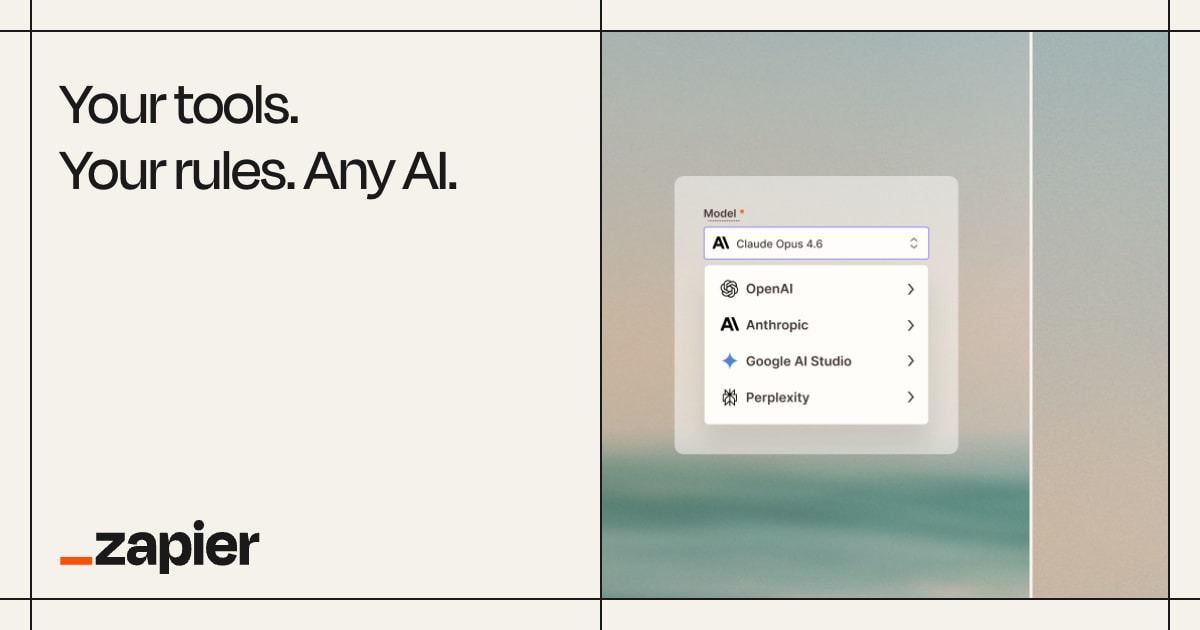
Zapier homepage art. Most apps, least drama — until Agents meet your privacy policy.
What it is
The glue.
Zapier connects SaaS tools with Zaps: trigger, actions, filters, paths. In 2026 the product is broader: Tables and Forms ship in Free/Pro/Team without separate add-ons, Canvas maps processes, and Zapier MCP lets agents call the integration catalog. Copilot helps draft Zaps. That is a platform, not only an if-this-then-that toy.
Pricing is task-based. Free is 100 tasks/month and two-step Zaps. Professional opens multi-step and premium apps; published entry paid tiers sit near $19.99/mo annually (about $29.99 monthly) at low task counts, scaling up with volume. Team adds shared connections and SSO from roughly $69/mo annually at the 2,000-task entry. AI by Zapier bills by model tier multipliers (Standard 1x, Advanced 3x, Premium 5x, plus tool calls). Agents use a separate activity quota (free ~400/mo, Pro add-on ~$33/mo annual for ~1,500).
I use Zapier when the job is moving records between apps I do not want to maintain. I move off Zapier when a workflow is chatty, needs complex branching in code, or must keep data on my VPC. The catalog is the moat. The task and activity meters are the leash.
Pricing
What it costs.
| Plan | Price | Note |
|---|---|---|
| Free | $0 | 100 tasks/mo; two-step Zaps; basic Agents/Chatbots access. |
| Professional | from ~$19.99/mo | Annual; ~$29.99 monthly at entry task tier. Multi-step, premium apps, AI steps. |
| Team | from ~$69/mo | Annual; shared Zaps/connections, SAML SSO, higher collaboration limits. |
| Enterprise | Custom | Advanced admin, SCIM, observability, annual task pooling. |
| Agents add-on | Free / from ~$33.33/mo | Activities, not tasks; Free ~400 activities, Pro ~1,500. |
| Chatbots add-on | from ~$13.33/mo | Tiered by bot count; separate from tasks. |
Prices as of August 2026. Confirm on the vendor page — meters move.
Does well
What works.
Connector coverage
If the SaaS tool is mainstream, Zapier probably has a trigger and action. That density still beats most competitors for operator speed.
Same-day glue
Non-engineers ship useful automations the same day. Autoreplay, versioning, and error controls on paid plans make it less fragile than hobby scripts.
Platform pieces included
Tables, Forms, and MCP in core plans reduce the old add-on spaghetti. Good for lightweight internal tools glued to SaaS.
AI inside the workflow
AI by Zapier and Copilot help extract, classify, and draft inside a Zap. BYO key keeps some AI steps cheaper when tool-heavy.
Falls short
What fails.
Task math gets hostile
Multi-step Zaps, premium AI tiers, MCP calls, and code runtime extensions all draw from one pool. A “simple” AI Zap can burn 3–5x tasks per run.
Agents are another meter
Agent activities do not use tasks, which sounds kind until you are budgeting two clocks. Fine for light copilots, awkward for busy desks.
Not a substitute for an app
Heavy transformation, long-running jobs, and strict compliance usually want n8n self-hosted, a queue, or real code.
Polling lag on lower plans
Free polls slowly. Near-real-time needs paid tiers or webhooks. Operators notice.
Who should
Buy this if.
Pick Zapier if your company runs on SaaS and you need glue between CRMs, inboxes, sheets, Slack, and billing tools without standing up infra. It is the default operator automation layer for a reason.
Skip or complement it if you are technical, volume-heavy, or privacy-constrained. n8n or first-party webhooks will be cheaper and clearer at scale. Use Zapier for edges, not for your core ledger loop.
FAQ
Questions.
- What counts as a Zapier task in 2026?
- Successful actions that move data, plus many AI/code/MCP units per the rate card. Triggers, filters, Paths, Formatter, Tables, and Forms steps generally do not. Failed actions usually do not count.
- Are Tables and Interfaces still add-ons?
- As of August 2026 plan updates, Tables, Forms/Interfaces, and MCP are included in Free, Pro, and Team rather than separate add-ons. Confirm your account email if you are on a legacy plan.
- How is AI priced?
- AI by Zapier uses model tiers with task multipliers and charges for tool calls. Premium defaults are convenient and expensive. Switch to Standard or BYO key when the job is simple.
- Zapier vs n8n?
- Zapier for catalog and non-technical owners. n8n for self-hosting, code nodes, and execution-priced complex graphs. Many teams use both.
Also on the desk
Compare next.
Self-hosted automation / agents · 8/10
n8n
The automation runtime technical teams actually self-host: fair-code core, execution-based cloud pricing, and agents that share the same meter.
AI chat · 8/10
ChatGPT
The default desk tool: broad, useful, and still capped when you need it most.
Multi-agent frameworks · 6/10
CrewAI
Fastest way to stage a multi-agent demo. Still thin when grants, budgets, and a scored finish line matter.